Lawyer talk for “prove the tech is the fault and not the operator of the tech.” Now if the governments want to indemnify the automakers like they do vaccine makers, you watch how fast these cars will come out! https://en.wikipedia.org/wiki/Vaccine_court
“We take privacy very seriously and do not collect the data the Motor Trend article claims such as throttle position, oil temp and coolant temp,” Google told The Verge.
So who can you trust, the automaker or the phone maker? They both have a vested interest and can change policy, but carmakers have more regulation to concern with.
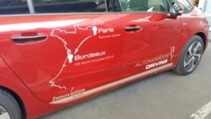
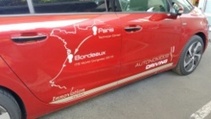
The Valeo laser scanner linked to the Valeo camera – which uses Mobileye image processing technology – scans the environment in front of the vehicle, detecting any obstacles with extreme precision.
For how long will Mobileye maintain the best algorithms for autonomous driving? As long as the community allows them to I think, an open platform will enable competition to achieve the level of performance and accuracy needed to drive our own cars.
This may be promising technology coming from obscure evaluation of wireless signals to determine distances and objects. Keep this work going to find a way to make driving safer, although will clearly need a second source to confirm the wireless information which is inherently unreliable.
Unintentional braking is much safer than unintentional acceleration I think, but field testing never seems to be enough. There are some good lessons here as we progress toward highly automated driving over the next decade. I’ll bet Ford wishes they had over the air update technology right about now.
Open source means more things than just free software, and, in the case of cars, we’re talking about collaborative platforms and diverse communities combining to design vehicles (or things for vehicles) more quickly and efficiently than the status quo.
Local Motors is pushing the envelope here with printed cars, but Open Source is already going into many production cars via Linux and community efforts such as GENIVI and AGL.
Despite what Musk and other futurists and technophiles say, both inside the automotive industry and out, autonomous vehicles (also referred to as self-driving, robotic, or driverless vehicles) have some hurdles to clear.
I think the industry really understands the hurdles, but is willing to take them on because there is a lot of money to be made along the way, and that seems ok.
“That’s where the chief financial officer says to the chief information officer, ‘Get out of the way, buddy, if we don’t do this, we’re going out of business.'”
One option for making auto software safer is to open it to public scrutiny. While this might sound counterintuitive, some experts say that if automakers were forced to open up their source code, many interested people — including coding experts and academics — could search for bugs and vulnerabilities. Automakers, not surprisingly, have resisted this idea.
Not such a bad idea, and at least 10 automakers are involved in open source code for the biggest section of code in the car, infotainment. Will open source methods apply in safety critical parts that drive the car? We shall see in the next few years who can lead that race.








 Hoffmann Group Consulting, LLC