The Olympics in Toyota’s backyard is a strong incentive to tell a powerful story to the world. The $1B should pay off in great brand exposure and leadership if they succeed.
The new SRAM is optimized for parallel processing of video data and will enable sophisticated video data processing such as obstacle recognition utilizing real-time processing of high-resolution vehicle camera videos and augmented reality (AR) display on the windshield
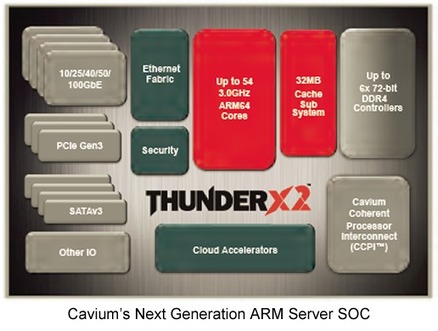
It’s clear that the hyperscale data center customers such as Alphabet’s Google (NASDAQ:GOOG) (NASDAQ:GOOGL) and Facebook (NASDAQ:FB) are very open to alternative architectures, and welcome competition with Intel
There are really only 3 big customer to win, and price will be a big factor. I doubt ThunderX2 will move the needle much toward ARM in the cloud, but it will hurt Intel’s margins.
The electric vehicle, which can carry up to 12 people, is equipped with some of the world’s most advanced vehicle technology, including IBM Watson Internet of Things (IoT) for Automotive
I get the car sharing model changing the road usage and freeing up lanes of traffic, but don’t completely understand how behavior of single person per car today will change just because there is no driver and it runs on electricity, not oil.
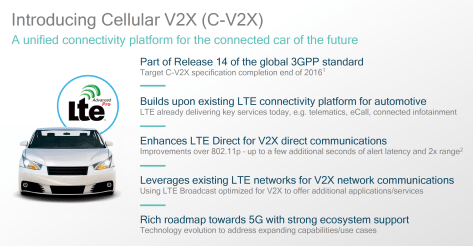
We see work both in LTE Advanced and 5G as critically important for delivering the kind of connectivity needed for autonomous driving, as well as being a very scalable and economically attractive way to drive V2X
Intel gets it on this one, I wonder if they are shaping the DSRC developments in LTE release 14 of 3GPP called C-V2X? Qualcomm may have the overriding market lead as 5G starts in 2020.
This may be why Tesla turned to Israeli software specialist Redbend, purchased last year by Harman International, to process the over-the-air rollout of its Autopilot driver-assist system in 2015
Not sure this factoid has been verified, but the publicity sure helps Harman/Redbend, who already has a massive install base using OMA DM protocol to do this work.
WaveCombo, the technology is generally known as vehicle-to-vehicle communication, or V2X. It can operate with its integrated 802.11p, 802.11n, Bluetooth, and 802.15.4 networks for V2V, V2I, and intra-vehicle applications







 Hoffmann Group Consulting, LLC