Among the advantages of analog is that is offers an infinite number of representations — for example, on a clock, as the hands move around the clock it can represent every single possible time, while a digital clock has a finite number of possible times it can represent
Contrary to popular belief, analog is not “bad”, in fact it is better than digital, proven example in the human brain – stores and thinks using analog. If computers could do this they’d be way, way more powerful. The software is too tough for most brains to write though. 😉
A Google search for “Internet of Things” term reveals over 280,000,000 results, thanks to the media making the connection between the smart home wearable devices, and the connected automobile
280M responses is a lot of IoT to sort thru. The Connected Car is just beginning to be on the search list. Matching cars up to home and wearables is a totally untapped market – if people care about it.
And if the U.S. had the same rate as Sweden—the country with the lowest crash death rate—about 24,000 fewer lives would have been lost and an estimated $281 million in direct medical costs would have been averted in 2013
I really hate it when they develop statistics comparing the US to Sweden since there’s almost no comparison possible. However, when it comes to saving lives in car accidents, I suppose whatever it takes is worthwhile.
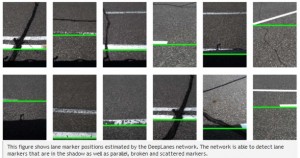
after a thorough evaluation of the results that they could proudly claim, “we are able to estimate the lane position in 99% of the cases with less than five pixel error”
Lane positioning and precise object location (in this case striped on the road) is one of the biggest challenges toward autonomous driving. Triple redundancy needs all the sources of information possible.
It’s becoming clear that extracting intelligence from that big data requires machine learning architectures which are better implemented with non x86 chips from companies like NVidia. It’s possible that by the end of this decade history might repeat itself in Intel’s most profitable segment.
Intel must think and execute like a startup, otherwise the failure in mobile will repeat as a loss at the enterprise – but not without a fight. More is to gain by offense than defense, however.
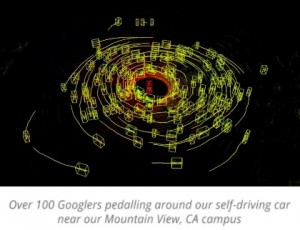
“We aim to give cyclists ample buffer room when we pass, and our cars won’t squeeze by when cyclists take the centre of the lane, even if there’s technically enough space.”
Bicycles and humans in general are the bane of self-driving cars.We riders are not so predictable and don’t always follow the laws and crossing markings.
Safety in cars boils down to data, and data requires communication to become information. A whole new generation of suppliers are coming to automotive from the Telecom space, with the discipline to match.
it will likely be the end of the decade before we really know how the car wars play themselves out. In the meantime, it’s going to be one of the most epic battlegrounds for both new world and old world businesses the market has seen in quite some time
What is missing from this excellent summary of the autonomous driving players is the critical Functional Safety element which will prevent any new player from joining the party until they have decades of proof points. No lawyer wants to take chances while technology is claiming to save lives, not lose more.






 Hoffmann Group Consulting, LLC