Concerns over government tracking of individuals, use of the data to monitor driving habits, and fears over malicious hackers triggering accidents have been a consideration since the first version of the IEEE 1609.2 security standard.
“We are left scratching our heads as to why the FCC still seems intent on excusing the behavior of T-Mobile and Sprint who have been offering these services without a waiver for quite some time,” said Jim Cicconi, senior executive vice president of external affairs at AT&T.
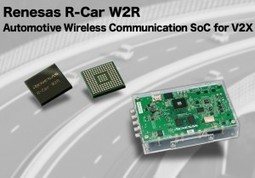
RSUs are 802.11p WLAN-based radio modules that reliably and securely transmit information such as speed limits, warnings of icy roads or other dangerous situations, traffic jams and construction warnings within a fraction of a second to passing vehicles and traffic control centers.
Here’s the chicken, now we need the egg. For at least a dozen years V2X has struggled to see who would go first, the roadside infrastructure or the carmakers. If the traffic lights are sending messages to equipped cars, we get immediate value from DSRC. Let’s go!
Lawyer talk for “prove the tech is the fault and not the operator of the tech.” Now if the governments want to indemnify the automakers like they do vaccine makers, you watch how fast these cars will come out! https://en.wikipedia.org/wiki/Vaccine_court
“We take privacy very seriously and do not collect the data the Motor Trend article claims such as throttle position, oil temp and coolant temp,” Google told The Verge.
So who can you trust, the automaker or the phone maker? They both have a vested interest and can change policy, but carmakers have more regulation to concern with.
The Valeo laser scanner linked to the Valeo camera – which uses Mobileye image processing technology – scans the environment in front of the vehicle, detecting any obstacles with extreme precision.
For how long will Mobileye maintain the best algorithms for autonomous driving? As long as the community allows them to I think, an open platform will enable competition to achieve the level of performance and accuracy needed to drive our own cars.
This may be promising technology coming from obscure evaluation of wireless signals to determine distances and objects. Keep this work going to find a way to make driving safer, although will clearly need a second source to confirm the wireless information which is inherently unreliable.
Unintentional braking is much safer than unintentional acceleration I think, but field testing never seems to be enough. There are some good lessons here as we progress toward highly automated driving over the next decade. I’ll bet Ford wishes they had over the air update technology right about now.







 Hoffmann Group Consulting, LLC