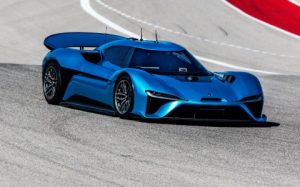
On February 23, the NIO EP9 drove autonomously without any interventions, recording a time of 2m 40.33s (two minutes, 40.33 seconds) at a top speed of 160 mph. The same day, the NIO EP9 also beat the fastest COTA lap time for a production car with a driver, achieving a lap time of 2m 11.30s (two minutes, 11.30 seconds) and reaching a top speed of 170 mph.
I want to challenge Silicon Valley, Detroit, and all other auto industry hubs to step up and help educate a skeptical public about the benefits of automated technology.
A time when our world is filled with self-driving cars that, according to Morgan Stanley, will deliver some $507 billion in productivity gains annually.
One of President Trump’s biggest pushes—and probably the only initiative getting bipartisan support—is a trillion-dollar transportation overhaul that could transform how highways and infrastructure are built.
A key accelerator is the enormous net benefit of the technology not just in terms of safety but also as increase of available personal time, competitive position (for companies and countries) and a significant decrease of costs (labour, fuel, insurance, capital).
Waymo engineers have driven down the cost of LiDAR dramatically even as we’ve improved the quality and reliability of its performance. The configuration and specifications of our LiDAR sensors are unique to Waymo. Misappropriating this technology is akin to stealing a secret recipe from a beverage company.
Nobody would question if Coca-Cola sued Pepsi for any attempt to steal their recipe, why question Waymo’s right to sue Otto and Uber? 9GB of documentation copied is not likely a mistake.
Automakers have argued that the rules could result in the loss of up to 1 million jobs because consumers could be less willing to buy the more fuel efficient vehicles since their engineering will result in higher price tags. The EPA had until April 2018 to decide whether the 2025 standards were feasible but in November moved up its decision to Jan. 13, just before Obama left office.
Read the full article at wardsauto.com (registration or login required)
This one must be fun for Trump’s team, given the determination by the prior administration to seal the EPA in a battle with automotive. If only we could build whole cars from carbon fiber like we do bicycles.
This approach comprises, amongst others, the cooperation with HERE as well as the cooperation with Intel and Mobileye on bringing highly automated driving to the streets by 2021 with the BMW iNEXT.
What I read is that if you buy a 2018 BMW, you’ll get the nextgen Mobileye technology that allows the vehicle sensors to upload to HERE live maps and tell other BMW’s what is in your area lately. By 2021 BMW will put some highly automated driving cars on the road which may rely on this new mapping tech to eventually self-drive. What part does Intel play? Money.
The struggle to prevent snoozing-while-cruising has yielded a radical decision: Ford will venture to take the human out of the loop by removing the steering wheel, brake and gas pedals from its driverless cars debuting in 2021
A bold decision for sure, unless the cars are driving in a controlled (referred to as geofenced) area. Then the cars will be better off without override by a human. So far this has not worked in real life situations, like flying.







 Hoffmann Group Consulting, LLC