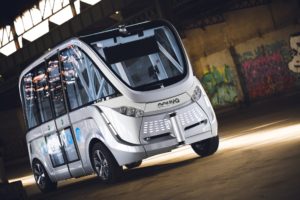
During the week-long pilot, the public will be invited to take free test rides of the driverless vehicle, which carries up to a dozen passengers and was designed for use by state and local governments and transit agencies and operators as an efficient, clean-energy alternative to the fossil-fuel powered vehicles of today
In the ARM world, Renesas recently released several third-generation R-Car starter kits that are optimized for both AGL and the rival GENIVI Alliance spec, which similarly focuses on open source Linux IVI development. The kits, one of which includes a newly announced R-Car H3 SoC, are designed for ADAS, infotainment, reconfigurable digital clusters, and integrated digital cockpits.
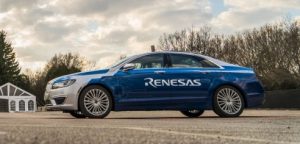
“We are pleased to have the University of Waterloo as a contributing partner to our new autonomous vehicle,” said Amrit Vivekanand, vice president, Automotive Business Unit, Renesas Electronics America. “With Waterloo, we have established a deep working relationship, engaging with them beyond traditional academic levels of collaboration.”
Universities are on the cutting edge of autonomous research, it makes sense to collaborate and build a community response to help automakers design these cars to be safe and buildable.
The company has used computer with less computational power which relys on less sensory data and hence built a cheaper car when compared to its competitors.
Autonomous will only catch on if the costs are low, and expensive, large computer chips will never make the mainstream and deliver the volume safety benefits.
Plans are to design it to operate without a steering wheel, gas or brake pedal, for use in commercial mobility services such as ride sharing and ride hailing within geo-fenced areas. It is expected to be available in high volumes
Geo-fenced areas are spaces where normal cars do not operate, perhaps a converted HOV lane that is otherwise unused since most cars have only one occupant. Ford is not making any claims they will SELL these in volume, only that they will be available, sort of like EVs.
Trucks have special safety and security requirements and could really use secure driver recognition to avoid their large trailers in acts of terror. Using an open platform such as Linux or Android could help make this happen.
Notice these savings COULD come if even multiple passengers used today’s cars too. The study also shows fuel use could increase if we make car TOO convenient.






 Hoffmann Group Consulting, LLC