Uber hires ex-Google Maps chief for driverless car project

Uber is getting serious about maps, and it has poached the former head of Google Maps to lead the charge. Brian McClendon, a Google engineering VP and 10-year company veteran, will be overseeing Ub…

Source: safecarnews.com

Google Maps + Uber = Autonomous taxi service? In Uber’s case I wonder where the savings will be, perhaps their drivers are the largest cost in their service. If you did not have drivers though, Uber will have to own the self-driving cars.  See labor analysis: http://time.com/money/3678389/uber-drivers-wages/. The real money is in the high resolution maps that all the geo mapping servers want. Uber drivers could help build and maintain that database with their cars I suppose.
JLR invests millions to make entire fleet connected

Jaguar Land Rover aims to have all its new vehicles connected by the end of this year and has spent millions to acheive this. Mike Bell, who was appointed global connected car director in 2012, told Automotive News Europe why this is so important to the carmaker.

Source: europe.autonews.com

100% of the new vehicle fleet connected is a pretty big goal. I wonder who else besides GM could make that claim?

Toyota to explore Ford’s SDL in-car smartphone app interface

(Reuters) – Toyota Motor Corp said it reached an agreement with Ford Motor to explore collaboration for the implementation of Ford’s SmartDeviceLink (SDL) technology in future Toyota and Lexus vehicles. SDL is an open source platform that integrates smartphones apps with vehicles through dashboard buttons, display screens and voice recognition technology.

Source: www.automotiveitnews.org

This update includes comments from both Ford and Toyota. If these companies can collaborate on the smartphone topic and further develop a solution, the majority of cars could have the same technology.

“Getting cross-department cooperation is critical.” Functional Safety at Jaguar Land Rover by Roger Rivett

“Getting cross-department cooperation is critical.” Functional Safety at Jaguar Land Rover by Roger Rivett – Roger Rivett works as Functional Safety Technical Specialist at Jaguar Land Rover, UK and is a long-time member of the International ISO 26262 Committee. During this year’s 5th International

Source: www.automotive-iq.com

It is not a trivial task to move up to functional safety (ISO262) as IVI developers will soon learn. It affects the entire organization including the OEM supply chain. This process is now being accelerated as OEMs are being compelled to demand ASIL A-D certification, not on the components of a system only, but the entire product. An ADAS rich vehicle that cooperates internally between the systems become a very complex and expensive platform if not pre-integrated to some extend. Departments inside and outside the carmaker need to cooperate, this is also known as the COMMUNITY. Borrowing methodologies from Open Source will help greatly here.

The OEM’s answer to CarPlay and Android Auto?

You might have missed a quiet announcement of great significance last week: Toyota would be joining Ford in supporting SmartDeviceLink (SDL). IMHO, that’s great news for the industry. I’m a huge fan of SDL because I think it solves the problems of mobile to car connectivity in the right way.Here’s a look at the current field for connecting cars to phones:
Apple CarPlay. Lets you get iOS apps into the car head-unit, following the look and feel guidelines set by Apple, and works only on Apple devi

Source: www.linkedin.com

The auto smartphone integration issues are now down to 3: Apple, Google, and Ford’s SDL. SDL is really the open version of Ford’s AppLink, and as a hosted project on GENIVI there is some work to be done to give the fit and finish for each car and brand. That’s good news because customization is what the industry wants, and brand identity that goes with it.

Automakers Concerned About Google Data-Mining Us In The Car

Unless you live a very isolated, disconnected existence, you’re probably leaving quite the trail for Google. Are you ready to leave more of a trail about how you stay connected in your car? Of course we already do drive around with GPS-tagging, server-connecting smartphones in our vehicles.

Source: www.automotiveitnews.org

Vehicle data storage and sharing is already an issue – before Google started mining your car. Try Bluetooth on your next rental car and see your private contacts be uploaded to the car and left there! This will only get worse, and Google’s Android Auto does not really care – all phones used in the car get treated equally open and shared. I wonder if Ford’s SDL has the same issues?

Linux World Domination Creates Shortage of Linux-Skilled Workers (2 Short Videos) – Slashdot

Linux Foundation Executive Director Jim Zemlin doesn’t use the phrase ‘world domination’ in these videos, but he could. He lists enough computing niches where GNU/Linux is the major player — from supercomputers to the next generation of automotive systems — that with or without world domination, …

Source: classic.slashdot.org

The shortage of available workers is a classic scenario when an economy is growing. This economy is the Linux economy, and growth into cars and other parts of IoT is driving the machine. 

Android Auto vs. Apple CarPlay: Google and Apple battle for dashboard dominance

Apple’s CarPlay and Google’s Android Auto have arrived on the scene and are now very comfortably nestled into the dashboard of CNET’s test car. I’ve been using the two dueling smartphone integration systems for a few months now — 8 months, to be exact, for CarPlay and 2 with Android Auto — so I think it’s time that we address the question on the tip of everyone’s tongue. Which one is better?

Source: www.automotiveitnews.org

You cannot deny the ubiquity of the Apple CarPlay and Google Android Auto in cars coming soon. Get used to this interface, although you may already be since it feels like your phone. Will safety of the user interface be better than fumbling around and dropping the phone between the seats occasionally? I think so. Will it add value to a carmakers brand? I think not. Can anyone stop the trend? Not likely.

Will your self-driving car be programmed to kill you if it means saving more strangers?

The computer brains inside autonomous vehicles will be fast enough to make life-or-death decisions. But should they? A bioethicist weighs in on a thorny problem of the dawning robot age.

Source: www.sciencedaily.com

The concept of your car being smarter than you is generally unattractive to most people that will be buyers of cars in the future. The missing element is a conscience, a uniquely human possession. Consciences demand moral training and are influenced by the environment each of us live in. I don’t think anyone will be able to train a robot or car to replicate that and own the liability that goes with it.

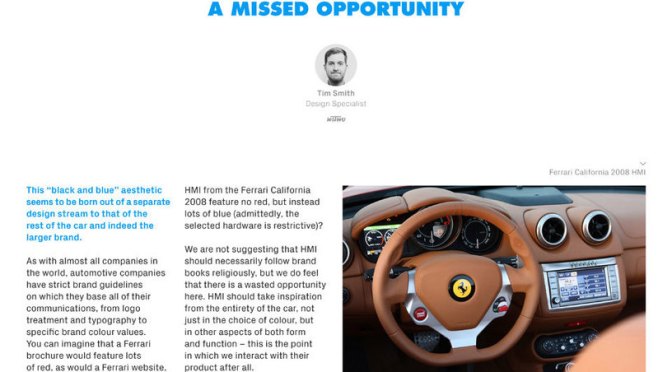
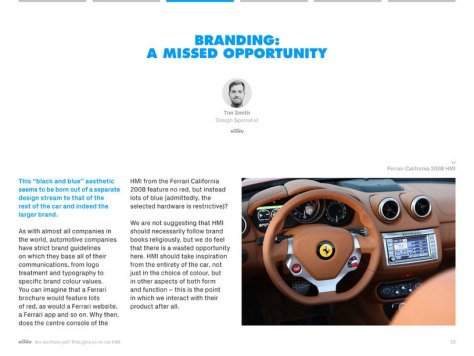
ustwo | Auto Blog on Design

With the ongoing integration of advanced computer systems into vehicles, the interfaces within are becoming ever-more complex. As the prime points of interaction between driver and car, these ‘human–machine interfaces’ (HMI) demand great care and attention from manufacturers, designers and engineers alike.

To that end, we have produced an eBook and 5-part blog where we look into this phenomenon of growing in-car HMI complexity. We explore our belief that an interface should match the evocative nature and elegance of an automobile’s exterior and interior design. We also outline our key thoughts on how, in partnership with manufacturers, we can bring an extra layer of care into the design of compelling experiences, in order to tame the beast that is in-car HMI.

As always, we welcome your feedback and views on this exciting subject. Please do contact us if you want to chat about any aspects of the eBook in further detail.

From all of us at ustwo, we hope you enjoy it.

Source: ustwo.com

Amazing what happens when design precedes engineering. ustwo came up with some remarkably effective and simple UX designs for the car, and they released them into the open source community.