It was only a short while ago that automakers seemed happy to get Pandora running on their dash, what happens when this becomes the next 8-track? Auto development cycles will never match CE.
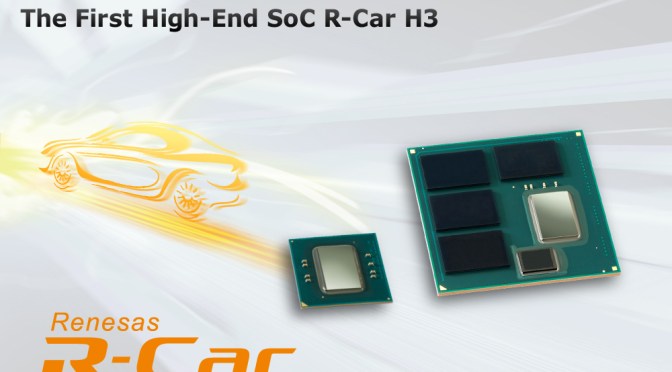
Perhaps the most important feature is out-of-the-box ASIL-B compliance enabling applications way beyond infotainment and into more complex ADAS, sensor fusion and autonomous driving. Support already for QNX, Integrity and Linux will enable quick development using the base of software already created for R-Car.
16nm technology speaks to the manufacturing team Renesas and its foundry have assembled to provide a sustained supply to the auto specific market (Renesas already shipping 887M MCUs per year to production cars). Incorporation of ARM A57/A53 cores is an impressing move to 64-bit along with key accelerators on die.
This part is not a promise, already shipping samples to customers and ready for SOP in 2019 car models. See it running at CES.
For how many years has telematics promised to pay for itself through passive advertising? This is more complex than it looks, I can see Google pulling it off and they will with Android Auto apps and phone, not the car itself.
“We view the data as your data,” Butler said. “We at Ford are merely stewards of that data on your behalf. We’re not doing anything without your informed consent and permission.”
“In the past you could take a knife and cut the brakes. But today you can hack a car remotely with a PC like you can hack an online store or a bank account,” Helmbrecht added.
The EU is just part of the effort to solve automotive cyber security. Can this be solved by governments or the private sector? Both will try since it is such as popular topic, albeit very complex.
The states continue to race for Federal funding to prove V2X works, of course it does – with limitations. Good to see at least one automaker on board, GM.










 Hoffmann Group Consulting, LLC