This industry-first in-car capability through Ford SYNC 3 AppLink simply requires drivers tap the voice recognition button on the steering wheel, then say “Alexa,” followed by a question or command.
Amazon Alexa seems so much more accurate and intuitive than Siri or other voice services. I wonder if the car environment will retain that ease of use.
More than simply a path, this is an architectural blueprint with three layers of redundancy and fail-operational design. It enables a hack proof automated driving system (SAE ADS) capable of SAE level 4/5 automation with ASIL D and low power for the real world.
Since no one knows when or how it will be possible to monetize autonomous cars, they’re investing billions in anything with the words Autonomy or Mobility, catchphrases of a seemingly inevitable future they don’t understand.
Just like watching a thrilling game of craps in Vegas, with everyone playing side bets and cheering on the high roller, there is excitement in self-driving cars and money will be made. The question is will they be safe-driving cars?
today announced a groundbreaking design for a solid-state LiDAR sensor that can deliver a subsystem cost of under $50 U.S. when sold in high-volume manufacturing scale
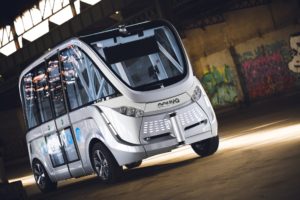
During the week-long pilot, the public will be invited to take free test rides of the driverless vehicle, which carries up to a dozen passengers and was designed for use by state and local governments and transit agencies and operators as an efficient, clean-energy alternative to the fossil-fuel powered vehicles of today
In the ARM world, Renesas recently released several third-generation R-Car starter kits that are optimized for both AGL and the rival GENIVI Alliance spec, which similarly focuses on open source Linux IVI development. The kits, one of which includes a newly announced R-Car H3 SoC, are designed for ADAS, infotainment, reconfigurable digital clusters, and integrated digital cockpits.
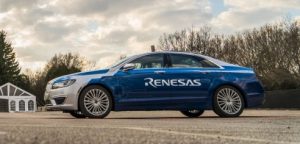
“We are pleased to have the University of Waterloo as a contributing partner to our new autonomous vehicle,” said Amrit Vivekanand, vice president, Automotive Business Unit, Renesas Electronics America. “With Waterloo, we have established a deep working relationship, engaging with them beyond traditional academic levels of collaboration.”
Universities are on the cutting edge of autonomous research, it makes sense to collaborate and build a community response to help automakers design these cars to be safe and buildable.
Watch John McElroy as he learns of the advanced safety engineering underway by Automotive Electronics leader, Renesas. Their focus is not just on self-driving, but rather on safe-driving using a fully balanced architecture with intelligent fail operational redundancy while retaining realistic power/heat specifications.
This is an architecture that can actually be built by carmakers. Six computers in 2 housings consuming a total of 25 watts – that’s about 10% of a typical Intel Xeon server or a couple Nvidia Graphics cards. And leaves room for secure communication overhead to prevent a hacker from taking over the car.
The company has used computer with less computational power which relys on less sensory data and hence built a cheaper car when compared to its competitors.
Autonomous will only catch on if the costs are low, and expensive, large computer chips will never make the mainstream and deliver the volume safety benefits.





 Hoffmann Group Consulting, LLC