Working remotely is a dream come true, if you understand a few tricks of the trade. Here are five ways to ensure that your work-from-home situation is a success and not a dud.
I like the comments about setting up your remote workspace to be hyper-productive. It’s not really much harder to work hard at producing, and much more satisfying than constant interruptions at the office. Why do you think colleagues tend to line up meetings in conference rooms all day, to avoid some of the chatter and take a mental nap?
There is a consensus in the market that despite all promises and forecasts, UBI has not become mainstream, and it is still in its infancy. Therefore, it is about the right time to stop the race for a moment and examine whether insurance telematics is going to be a success story, or is rather a bubble.About a month ago, in May 2015, the British Insurance Brokers Association (BIBA) released a research, showing the figures of UBI in the UK. The research showed that the number of live UBI policies i
I like the approach suggested, and believe one of the issues is the single data source and provider model. Imagine the internet where you decided what website to go to, and they provided the connection and service. Not much value in the long run. What is needed is a truly open connection when aggregators and service providers can compete to obtain your data (in exchange for something you want) and offer it to multiple payers. Also, all the cars need to use the same system for connectivity and communication – an open model. There are plenty of technical solutions to this and if the UBI providers will take a long term approach, they can conclude there is no profit in being a closed architecture.
The third and biggest piece on display was the Movimento OTA solution and the way this worked even with the connectivity issues on the exhibit floor was impressive. Movimento’s solution was integrated on Melco’s head unit and has the ability to update every ECU in the vehicle and this is where both SOTA and FOTA are in action. Users also have the ability to schedule their updates and this is the similarity with the Tesla system. The difference being Tesla vehicles were engineered for updates but the Movimento solution can do it on any other vehicle despite electrical network challenges.
Over-The-Air (OTA) becomes sexy in cars, something phones could not live without due to the frequency of updates needed to fix bugs after shipment and address security issues over time. Phones have a short development cycle whereas carmakers seem to think they can use long cycles to uncover bugs before start of production (SOP). Truth is that many cars ship with hundreds if not thousands of known bugs. SOP date pressure creates a panic at the end of the cycle. Good to see that Volvo and others are discovering a more reasonable approach and one that scales over time.
As Wallach, Lin and other ethicists wrestle with the philosophical complexities, Gerdes is conducting real-world experiments. This summer on a racetrack in northern California, he’ll test automated vehicles programmed to follow ethical rules to make split-second decisions, such as when it’s appropriate to disobey traffic laws and cross a double yellow line to make room for bicyclists or cars that are double-parked.
Gerdes is also working with Toyota to find ways for an autonomous car to quickly hand back control to a human driver. Even such a handoff is fraught with peril, he says, especially as cars do more and driving skills degrade.
Ultimately, the problem with giving an an autonomous automobile the power to make consequential decisions is that, like the robots of science fiction, a self-driving car still lacks empathy and the ability to comprehend nuance.
“There’s no sensor that’s yet been designed,” Gerdes says, “that’s as good as the human eye and the human brain.”
I used the human eye illustration in the past, emphasizing that 40% of the central nervous system connections join the eye to the brain, double most other senses. Eyes are critical to driving and brains are even more so. The sensors we can develop and camera technology will only make them better, but not replace them. There is plenty of room for innovation and business in ADAS even if we don’t get a car to fully drive itself in complex environments.
Automakers are developing one of the largest public key infrastructure security systems ever conceived, the heart of an effort to protect a new generation of networked vehicles that is expected to hit the mass market by the early 2020s.
This is a problem the automakers and NHTSA + DOT + DOD funding has been investing in for over a decade. The security concerns over “connected cars” that do more than entertainment is obvious. For the solution we are now focused on PKI, which is not absolutely secure, but the best we have. One issue is the need for connectivity to the internet 12 times an hour to get a new security key, among others that have been published. If these problems can be solved, the Connected Vehicle (implies the safety focus) will generate billions in revenue for the US economy, thus the continued push.
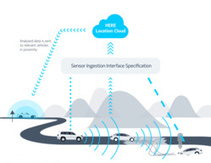
HERE published yesterday an interface specification that defines how sensor data gathered by vehicles on the road can be sent to the cloud to update maps on the fly. The specification has been published under a Creative Commons license. With a growing number of sensors in car and the connectivity…
Engineers love specs, open or not. This is a great move by HERE to raise the bar of delivery so all cars can benefit. It will help them build long term relationships with many OEMs as well as move more innovation in the otherwise closed automotive space.
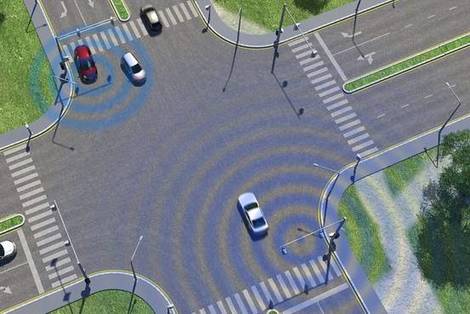
General Motors expects to begin testing new technology from Cisco Systems to share spectrum between vehicle-to-vehicle and Wi-Fi systems, a GM executive told U.S. lawmakers.
I like this approach of working the tech and auto industry together to find a solution to the wasted spectrum in 5.9Ghz that has been waiting for a real implementation lead. Perhaps GM will play this role as they testify to US Congress today. I look forward the reduction in political gridlock and a move to bring in the technology solutions.
This is a fantastic idea, and a great way to sell lots of LCD monitors in a safety setting. I wonder how many truckers will implement and both confuse and entertain the drivers behind them. Reminds me of the transparent Bond car with a fully LED projection paint job (http://jamesbond.wikia.com/wiki/Aston_Martin_V12_Vanquish):
The V12 Vanquish rose to fame after being featured as the officialJames Bond car in Die Another Day, the twentieth James Bond film. In the film, the Vanquish has the usual Bond film embellishments, including adaptive camouflage which rendered the vehicle virtually invisible.
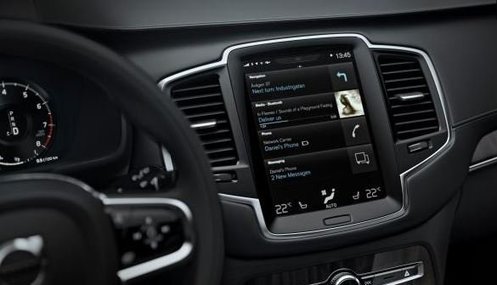
Excellent summary of how many complex IVI systems are not making customers happy, leading to entry by external players (Read: Apple/Google/others). Time to focus on ADAS and driving systems while IVI becomes less valuable.
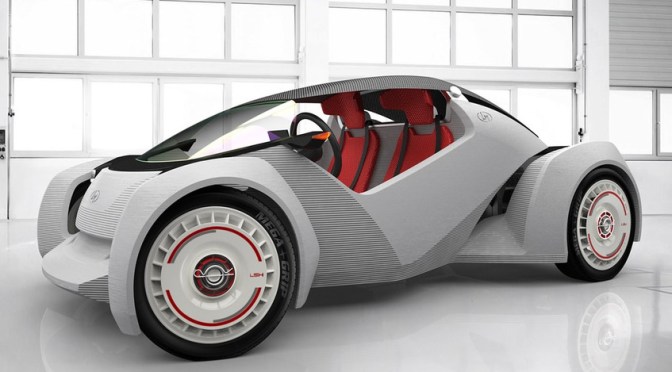
A new kind of car manufacturer relies on the cloud to keep its virtual community of designers in sync If you’ve heard of Local Motors, it may be because of an audacious stunt the company pulled at Detroit’s North American International Auto Show in January, using a giant 3-D printer to print a car called …
Local Motors may never have a large production line, but they can certainly teach some lessons that are no less significant than Tesla has. The auto industry is starting to understand how leveraging the community is better than leveraging the suppliers.












 Hoffmann Group Consulting, LLC